Bhrag
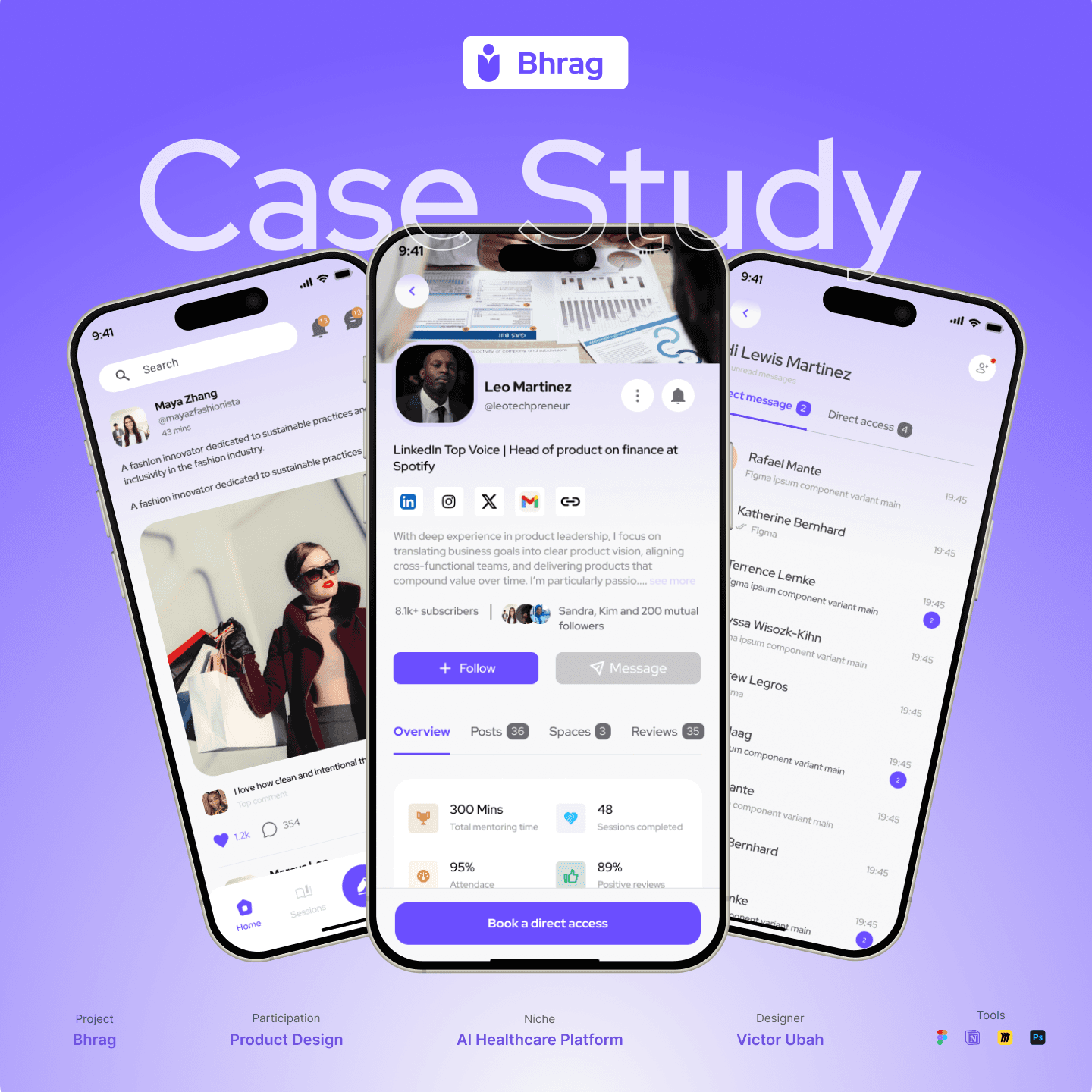
Bhrag is a social platform where paid access sits on top of an open feed. Anyone can post and comment; anyone can create a space others subscribe to weekly or monthly; and anyone can set their own availability and price for one-to-one sessions. There is no separate mentor account — every user is both mentor and mentee.
The problem
Mentorship platforms treat expertise as a credential. It is really a relationship you can already see.
Existing platforms gate mentors behind applications and vetting, which is slow, small, and assumes the platform is a better judge of who is worth listening to than the person seeking help. Meanwhile the actual behaviour already happens elsewhere: people follow someone's thinking for months on LinkedIn or X, decide that person is worth an hour, and then have no way to buy that hour.
Bhrag closes that gap. It is a social feed where anyone posts and anyone comments, with paid access layered on top, and critically, no separate class of mentor. Every account is both. You set your own availability and pricing, and you book with other people. Peers who are ahead of each other in different things, which is how mentorship works in practice.
A paid product built on other people's behaviour has to answer the objections before the user finishes forming them. So the design is organized around four of them.
“Why would I pay to follow someone I can already read for free?”
The Answer
Subscription buys a space, and a space opens completely.
Spaces are the paid unit, created by anyone, priced weekly or monthly by whoever runs them. Subscribing opens everything inside. No second paywall, no post-by-post charges once you are in.
The reference model is Twitch rather than a magazine. Subscriptions are per-person, not platform-wide. A card can carry fifteen of them at once, each renewing independently and each lapsing on its own if the value stops. That keeps the pressure where it belongs, on the person charging, every single cycle.
“What am I actually buying when I book a session?”
The Answer
Not thirty minutes. A prepared conversation.
Booking opens a private chat with that person immediately, not at the session, at the moment of payment. If the session is two weeks out, that is two weeks of access beforehand.
This is the decision I would defend hardest. Paid mentorship sessions fail in a predictable way: the first third disappears into context-setting, the middle finds the real question, and time runs out before the answer. Both people leave feeling it was pleasant and useless.
The window moves context transfer out of the session. The mentee arrives with background sent and questions sharpened. The mentor knows what is coming. The session starts at the real question instead of arriving at it.
“So after we talk, can I still reach them?”
The Answer
Two channels, and the paid one closes when the session ends.
Session chat - paid | Open DM - free |
|---|---|
Opens at booking, closes when the session ends. Priority attention, bounded by the thing that was paid for. | Anyone can message anyone, Instagram-style. No guarantee of a reply, and in practice paid conversations get answered first. |
Splitting them protects the mentor. Without a closing point, every session becomes an unbounded obligation, and the people most worth booking are exactly the ones who would stop offering sessions. A defined end is what makes the supply side sustainable.
“What if I pay and they simply don't show up?”
The Answer
Reschedule first, refund if not, decided by a person, not a rule.
A no-show triggers rescheduling. Where that fails, the case goes to an internal admin review that decides between a rebooking and a refund.
Human review is the right choice at this stage. No-shows have context, emergencies, time zone errors, genuine bad faith, and an automatic refund rule would punish all three identically while inviting abuse from the other side.
Everyone is both
No mentor class, no application, no vetting. One account type that does both jobs.
The same person books a session on Monday and hosts one on Thursday. That removes the hierarchy most mentorship products are built on, and it is closer to the truth, expertise is local, and almost everyone is ahead of someone.
It also removes the platform's ability to vouch for anyone, which is the cost of the decision. Credibility has to come from what is visible instead: posts in the feed, history, reviews from people who actually paid. The social layer is not an engagement feature bolted onto a marketplace. It is the evidence the marketplace runs on.
Reflection
The hardest part of a paid access product is protecting the person being paid.
Most of the design pressure came from the demand side, make it cheaper, make access wider, keep the channel open longer. Every one of those is good for the buyer and corrosive for the seller, and a marketplace with no sellers left is not a marketplace.
The bounded session chat is the clearest example, and I still think closing it too sharply is the weakest decision in the product. What I would change is not the principle of a boundary but its shape. A short grace window after the session costs the mentor almost nothing and captures the question that is most worth answering. I would rather state that now than discover it from churn data after launch.

